

Hydrogen Permeation
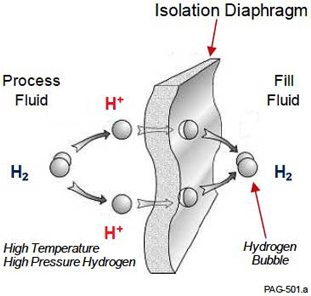
Hydrogen Permeation is the penetration of hydrogen ions through the thin metal isolation diaphragms of a pressure transmitter. Over time, this penetration will cause errors in measurement. Hydrogen is normally found in nature in a diatomic state (a H2 molecule). In this state, hydrogen cannot penetrate the thin (0.001 inch to 0.002 inch thick) isolation diaphragms because the H2 molecule does not have enough energy, due to its size, to push through the lattice structure of the metal isolation diaphragm. However, if the hydrogen molecule splits into two hydrogen ions (H+), then, due to its reduced size, the H+ ion can draw enough energy from the process to push its way through this lattice structure. Once on the other side of the isolation diaphragm, the H+ ion will reform H2 molecules with other H+ ions that have also passed through. The H2 molecules become trapped inside the fill fluid of the transmitter because they are once again too large to pass back through the isolation diaphragm. Gradually, the H2 molecules will dissolve into the fill fluid. Over time the fill fluid will become saturated and a hydrogen bubble will form. This hydrogen bubble will cause zero and span shifts, degrading the performance of the pressure transmitter. In extreme cases, the hydrogen bubble can build up enough volume to force the isolation diaphragm to expand outward causing cracking of the isolation diaphragm. This phenomenon is known as "Jiffy-Pop". These cracks will lead to leakage of the fill fluid into the process and the complete failure of the pressure transmitter.
Introduction
Hydrogen is the simplest and smallest atomic element. Water, acids, bases, and the immense family of organic compounds all contain hydrogen. Even though hydrogen is not corrosive, it can cause problems for pressure transmitters through Hydrogen Permeation.
Conclusion
Appropriate material selection of the transmitter's isolation diaphragms is the important key in protecting a transmitter from hydrogen permeation. The selection of the material is the customer's responsibility. If there is any doubt about the level of risk of hydrogen permeation in a process, select Yokogawa's Gold-plated diaphragm.
Featured Products
 |
 |
 |
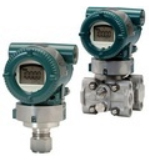 |
| Liquid Level | Differential Pressure | Draft Pressure | Gauge Pressure |
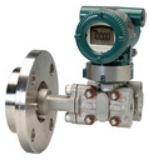
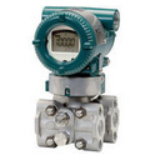
| Accurate level readings are essential to the safe, reliable, profitable operation of your plant. Liquid Level transmitters measure differential pressure to infer the level in a vessel. | Differential Pressure transmitters compare two pressures and transmit the difference to a control unit. Differential Pressure transmitter have a limitless number of industrial applications. | Draft Pressure transmitters are a unique type of differential transmitter that is designed to measure small differences in very low static pressure environments. | Gauge Pressure transmitters compare a pressure relative to atmospheric measure. |
|
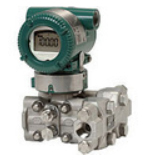 |
|
|
| Absolute Pressure | Low Flow | Mass Flow (Multivariable) | Multi-Sensing |
| Absolute Pressure transmitters compare a pressure relative to Absolute pressure. Absolute pressure is always a positive value. | Using Bernoulli's equation, Differential Pressure transmitters can be used to infer the flow of fluid through a pipe. | There are several technologies on the market to measure mass flow. One is the Multi-variable Pressure Transmitter. | A Multi-Sensing transmitter combines a differential pressure transmitter, gauge pressure transmitters, and temperature transmitter into one field instrument. |

